1. Arrival in Münster: A City Draped in Green and Stone
The train pulled into Münster Hauptbahnhof under a sky thick with spring clouds. The air, scented faintly with rain and freshly turned earth, bore that unmistakable clarity found only in cities embraced by green. Münster, as I would soon learn, is a city where history isn’t relegated to museum displays or dusty archives—it speaks through its stones, squares, and spires.
The route I had mapped began at the very intellectual heart of the city: the University of Münster. From there, I would follow a path that wove through centuries of culture, devotion, scholarship, and civic pride, ending at the timeworn yet stately steps of the City Hall, which once stood witness to the signing of the Peace of Westphalia. Between those two poles of academia and governance lay a world of discovery.
2. First Light at the University of Münster: Foundations of Knowledge
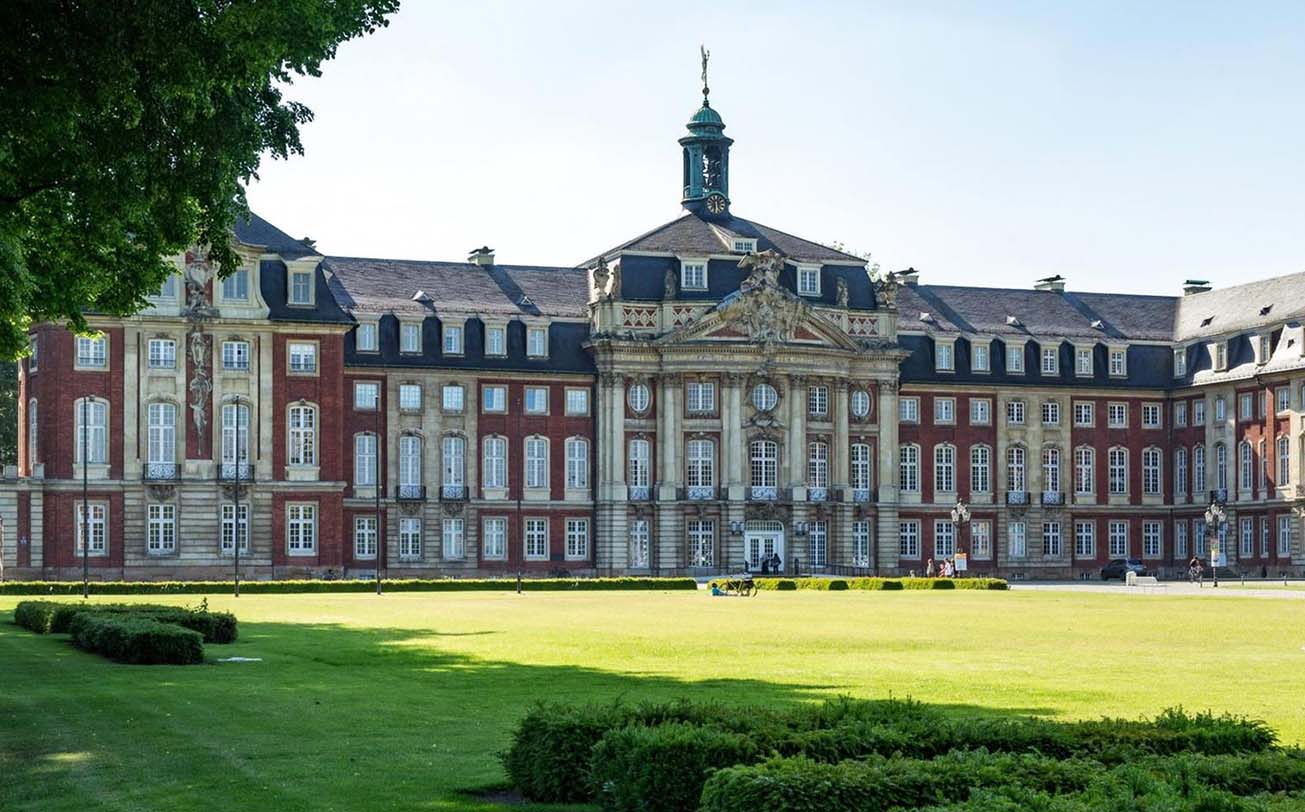
The morning air carried a scholarly hush as I approached the main building of the University of Münster, or Westfälische Wilhelms-Universität Münster, an institution that traces its origins back to 1780. The Baroque palace facade of the Fürstbischöfliches Schloss Münster, now the university’s administrative seat, stands not only as a testament to aristocratic ambitions but as a symbol of the Enlightenment values that still shape academic discourse within these walls.
Students cycled past with effortless grace, their bikes whispering over cobbled paths, a familiar rhythm in Münster’s daily life. I took time to walk around the Schlossplatz, letting my eyes linger on the ornate sculptures and wrought iron gates. The way the building sat against the manicured lawns, with tree-lined avenues radiating outward like an intellectual constellation, left an impression of enduring dignity.
Behind the palace, the Botanical Garden—established in 1803—offered a quiet retreat into structured nature. As I wandered among rare alpine plants, medicinal herbs, and tropical specimens housed in warm greenhouses, the commitment to research and conservation became palpable. The garden felt like an open-air library, each plant a leaf in a never-ending academic manuscript.
3. A Walk Through Geiststraße: Where the Secular Meets the Sacred
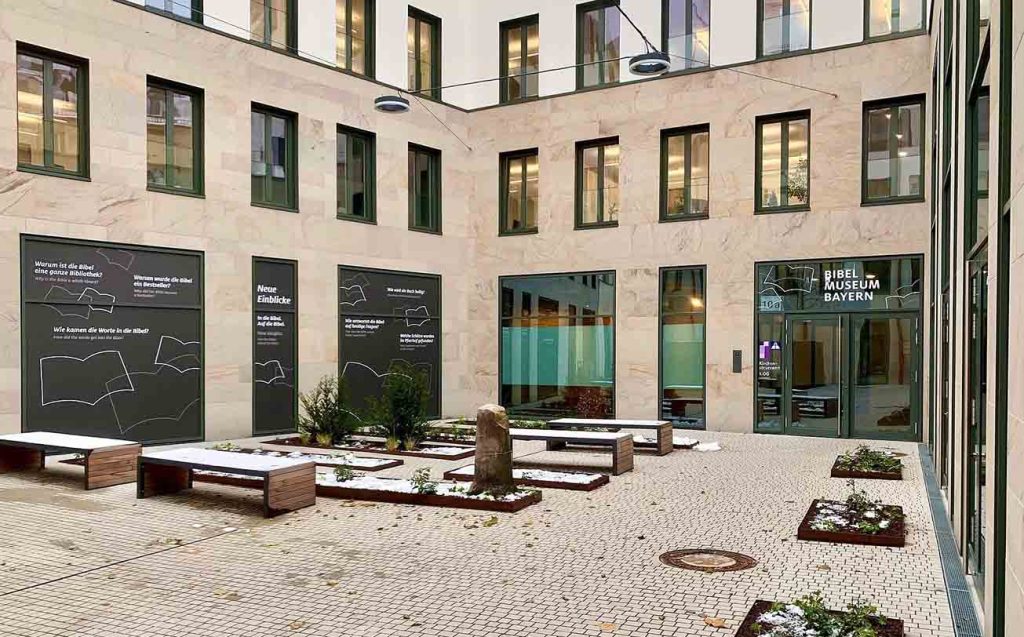
Leaving the university’s western edge, I stepped into Geiststraße, a street that seems to embody the gentle tension between secular and sacred history. Old academic buildings coexisted with quiet chapels. I paused at the Bibelmuseum, dedicated to the history of the Bible, not only as a religious text but as a literary and cultural artefact.
Inside, early printed Bibles, Hebrew scrolls, and illuminated manuscripts told stories of translation, transmission, and theological debate. The museum’s layout, though modest, invited deep contemplation. It underscored how Münster had long been a crucible of thought, where faith and reason intertwined rather than collided.
4. The Promenade: A Green Belt of Memory
Stepping onto the Promenade—the circular boulevard that traces the outline of the old city walls—was like entering a green cathedral. Towering plane trees stretched their branches overhead, forming a natural arcade. Cyclists, joggers, dog-walkers, and families all shared the space, each adding their own quiet rhythm to the city’s collective heartbeat.
Originally the site of medieval fortifications, the Promenade now serves as Münster’s most beloved pedestrian thoroughfare. Its circumference, spanning over four kilometers, provides not only a means of movement but a meditative loop through time. It reminded me of the circular cloisters found in old monasteries—spaces for reflection and silent perambulation.
At intervals, old bastions and markers gave subtle nods to the past. A plaque here, a sculpture there. One of the most evocative was the Denkmal für die Verfolgten der NS-Diktatur, a memorial to the victims of the Nazi regime. The words etched into stone offered a stark counterpoint to the laughter of nearby children and the bright flowers blooming just a few meters away. History here was not merely acknowledged; it was absorbed into daily life.
5. The Lamberti Church: Witness to Civic Turmoil
Veering off the Promenade, I made my way to Lambertikirche, the Church of St. Lambert. Its Gothic tower pierced the sky, flanked by the infamous iron cages where the corpses of the 16th-century Anabaptist leaders were once displayed. These relics of religious radicalism, still suspended high on the tower, serve as eerie yet important symbols of Münster’s turbulent Reformation period.
Inside, the mood shifted from grim remembrance to serene transcendence. Sunlight spilled through stained glass onto worn stone. The organist was rehearsing, his music echoing like a prayer threaded through architecture. I sat for a while in one of the pews, watching as tourists came and went, some whispering reverently, others simply pausing to gaze upward.
The church’s mix of aesthetic grace and brutal history embodied a larger truth about Münster: beauty and suffering often share the same space.
6. Prinzipalmarkt: An Arcaded Memory Lane
Emerging from the shadows of Lambertikirche, I found myself in Prinzipalmarkt, Münster’s storied market square. The arcades stretched along both sides like open arms, each arch leading to a boutique, café, or jeweler nestled in centuries-old merchant houses. The facades—rebuilt with painstaking fidelity after World War II—retained their original Gothic and Renaissance character, though now they concealed modern amenities and enterprises.
Market stalls were being dismantled as I arrived; the scent of roasted almonds and fresh bread still lingered. I paused at a café under one of the arcades, ordering a slice of Westphalian Pumpernickel cake and a strong coffee. The rain had held off, and the square seemed suspended in a kind of golden calm, the weight of history lifting momentarily in the breeze.
The square had seen medieval trade fairs, religious processions, war parades, and peace proclamations. Every stone underfoot felt embedded with human endeavor. I walked slowly, allowing each building to reveal its details—carved reliefs, heraldic symbols, inscriptions worn smooth by time and touch.
7. The Historical City Hall: Birthplace of Peace
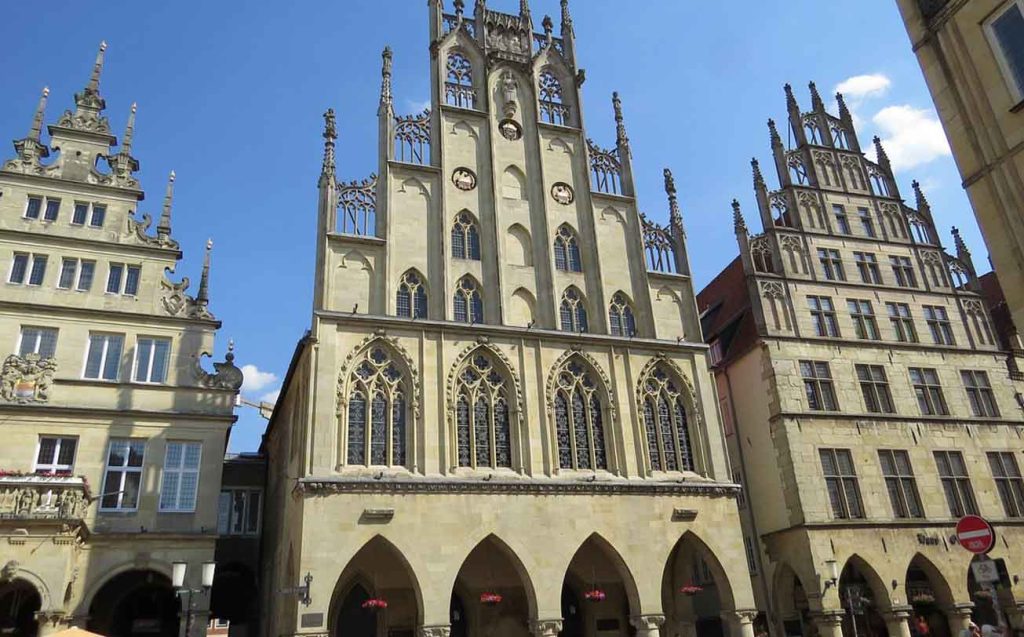
At the far end of Prinzipalmarkt stands the Historisches Rathaus Münster, whose slender Gothic gables and crow-stepped rooflines call to mind the civic pride of the Hanseatic League. It was here, in the Friedenssaal (Hall of Peace), that the Peace of Westphalia was negotiated in 1648, ending the Thirty Years’ War and reshaping Europe.
A guided tour offered access to the room where history had turned. Dark wood paneling and solemn portraits lined the walls. The long table, flanked by chairs once occupied by diplomats from the Holy Roman Empire, France, Sweden, and the Dutch Republic, held an atmosphere of enduring gravity.
I listened as the guide spoke of painstaking diplomacy, of months—years—spent hammering out terms that would allow weary nations to coexist again. The peace treaties signed here became templates for modern international relations. The Hall of Peace was more than a room; it was a birthplace of new thinking.
Outside, the building’s sandstone façade caught the light differently depending on the time of day. Late afternoon cast it in hues of amber and rose, drawing the eye upward to the ornamental tracery. Children ran across the square, their shouts mingling with the clang of a distant tram and the clatter of café cups. The City Hall stood as both sentinel and participant in this ever-unfolding urban play.
8. Zwischenahnen: Stops Between the Milestones
Between these monumental sites lay countless smaller moments. An old bookshop tucked beside a university building where I found an early edition of Heine’s poems. A narrow alley where ivy crept across red-brick walls, turning an ordinary building into a vertical garden. A street musician playing Bach on a viola da gamba near Domplatz, drawing a semicircle of listeners who applauded not with noise but with reverent silence.
One afternoon I found myself in the Kunstmuseum Pablo Picasso, the only Picasso museum in Germany. Its collection—focused on lithographs and line drawings—presented a different kind of cultural weight. The building itself, a former publishing house, retained its Jugendstil character, creating a dialogue between 20th-century creativity and 19th-century ornamentation.
9. The Diocesan Library and the Echoes of Monastic Learning
No cultural route through Münster would be complete without entering the Domsplatz area, where the St. Paulus Cathedral rises like a stone hymn. Just behind it lies the Diözesanbibliothek, the diocesan library, whose modern glass structure contrasts with the Romanesque austerity of the cathedral.
Inside, the library revealed its treasures: early theological treatises, illuminated manuscripts, and codices that once belonged to clerics who debated the very doctrines shaping Christendom. The reading rooms were quiet, bathed in natural light, the only sound that of pages turning and pens scratching. I spent a quiet hour with a facsimile of the Speculum Humanae Salvationis, marveling at the miniature artistry and the faith it portrayed not in gold leaf, but in structure and symmetry.
10. Evening Reflections Along the Aasee
As twilight crept across the city, I wandered toward Aasee, Münster’s beloved inner-city lake. Swans drifted silently over its surface, their reflections fracturing in the breeze. The lakeside promenade, with its contemporary sculptures and benches made for contemplation, offered the perfect closure to a day spent moving through layers of time.
The Aasee reflects more than light. It reflects the cultural maturity of a city that has embraced art, science, memory, and progress without discarding its past. Couples walked hand in hand. Joggers passed by with headphones and steady breath. The spires of nearby churches glowed dimly in the fading sun, echoing the ancient and the eternal.
11. A City as Text: Reading Münster Anew
To walk from the University of Münster to the City Hall is to move through a city-sized manuscript—each block a paragraph, each monument a chapter, each citizen a footnote that keeps the story alive. The route is not long in terms of kilometers, but it spans centuries of human aspiration, conflict, learning, and reconciliation.
Münster reveals itself gradually, like an old volume read by candlelight. Its gifts are not loud or ostentatious. They are architectural, intellectual, and spiritual. They require time, attention, and the kind of respect one brings to sacred or scholarly spaces.
Along the way, I did not simply visit buildings. I encountered ideas, and those ideas now travel with me.