1. Early Morning in Osnabrück: Departure into the Quiet
The day began with a faint chill brushing the cobblestones of Osnabrück’s Hauptbahnhof. Morning light spilled through the high arched windows of the station, giving the platforms a subtle golden sheen. A modest breakfast from a nearby bakery—crisp buttered brötchen and hot filter coffee—offered a quiet comfort before boarding the train.
Tickets had been pre-booked through the official Deutsche Bahn website (bahn.de), which provides an efficient, bilingual interface for planning trips across Germany. The process is straightforward: input departure and arrival stations, choose the preferred train type (in this case, a regional RB or RE), and confirm seating if necessary. Mobile ticketing, QR scanning, and real-time delay alerts streamline the journey planning. For this trip, the selected route was operated by WestfalenBahn, known for clean cabins and punctual regional services.
Departure was prompt. As the train glided out of Osnabrück, the first glimpses of Lower Saxony’s countryside unfolded through wide panoramic windows.
2. The Rail Itself: A Living Heritage of Steel and Steam
Stretching approximately 70 kilometers, the Osnabrück–Bielefeld line weaves through a transitional landscape of rolling fields, dense beech forests, and quiet villages that cling to the land with a dignified stillness. Historically, this route held significant logistical and economic importance. Opened in phases in the late 19th century, the line once served as a vital link for coal and timber trade, a role that has since evolved into a quiet passage for commuters, students, and the occasional camera-laden traveler.
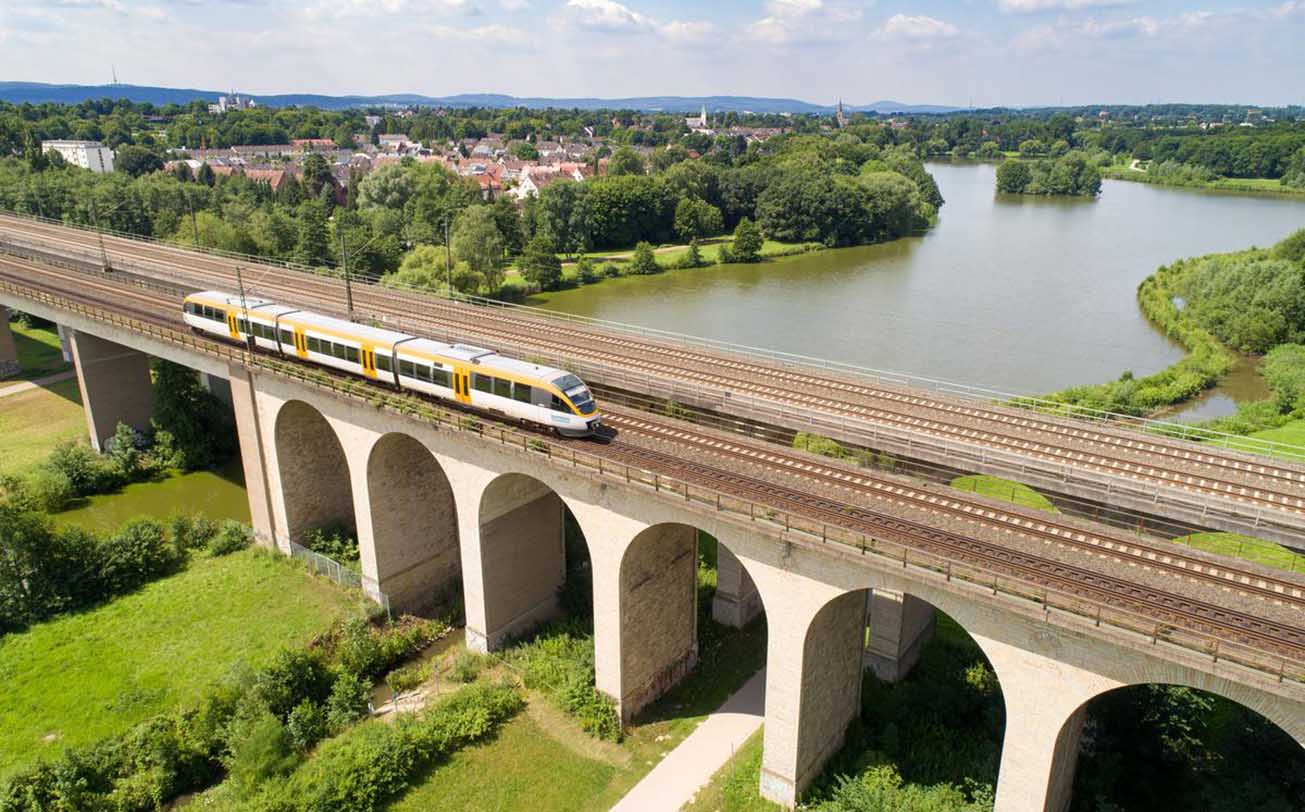
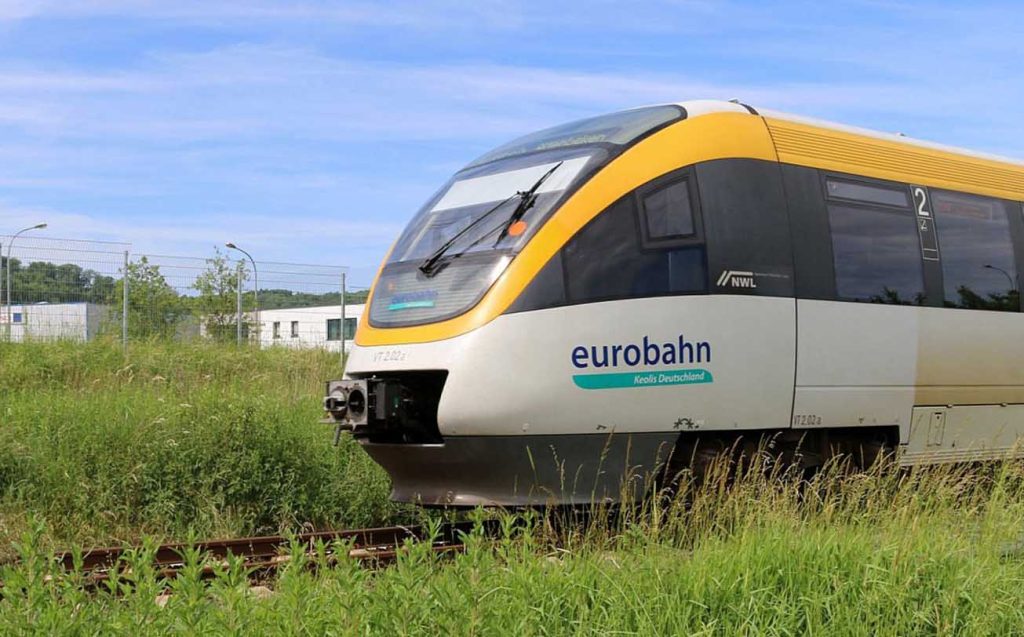
The train, an Alstom Coradia Continental EMU (electric multiple unit), hummed steadily along welded tracks. These modern trains, despite their contemporary design, run over a railway bed that resonates with echoes of the past. From a seat near the window, every curve of the line felt considered, every elevation change intentional. Bridges, embankments, and occasional semaphore signals gave subtle nods to the line’s heritage.
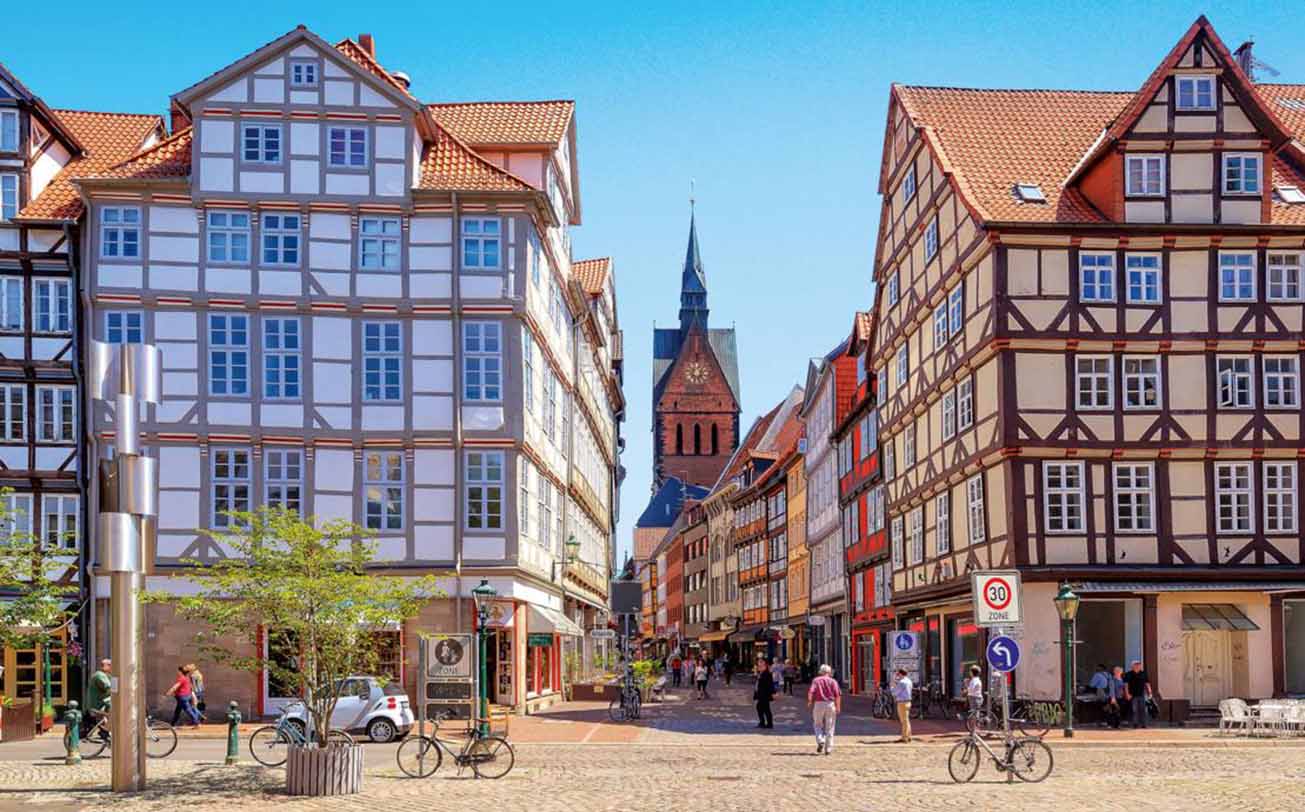
Between stations, the train occasionally picked up speed, skimming past woodlands and pastures in swift silence. Sheep-dotted meadows rolled by, interrupted only by clusters of Fachwerkhäuser—traditional timber-framed houses that look unchanged since the early 1900s.
3. Hidden Stations with Character: Stops Along the Way
Halle (Westf)

Among the more memorable stops along the route was Halle (Westf), a small town with an understated charm. The station platform was simple, functional, and clean, with the town’s rooftops just beyond a low hedge. Stepping out here for a short stroll during a scheduled connection revealed cobbled lanes leading to a baroque church and a handful of local bakeries with enticing signs like Frischer Apfelstrudel. For those with time to explore, Halle offers a serene break from the kinetic motion of the railway.
Borgholzhausen
Further along, the train paused at Borgholzhausen, nestled into the Teutoburg Forest’s northern fringe. Here, the landscape takes on a more wooded aspect, the trees crowding closer to the tracks, as if inspecting the train’s passage. The town is known for its quarrying history and distinctive sandstone architecture. Just beyond the station, a stone arch bridge framed a postcard-worthy view of the town’s main street, flanked by quiet homes and small artisan workshops.
Each station felt like a punctuation mark in a longer sentence—rhythmic, deliberate, yet filled with local texture.
4. Landscapes That Tell Stories
Between Halle and Brackwede, the train route skirts close to the edge of the Teutoburg Forest. Here, the foliage grows denser and the light filters through in dappled gold. Occasionally, deer might be spotted near the tree line, their presence fleeting but unmistakable. The smell of damp pine and the muffled rustle of the wind in the trees seeped through the air vents of the train cabin in subtle waves.
This portion of the journey reveals the terrain’s subtle complexity. Far from being flat farmland, the Westphalian landscape undulates gently, shaped by ancient glacial movement and centuries of agricultural cultivation. Farms are demarcated not by barbed fences but by rows of oak or hedgerows, and every so often, the steeple of a Lutheran church rises above the fields, its bells audible even from inside the train.
Trains along this route don’t rush. Their speed feels matched to the landscape’s pace—a gesture of respect more than engineering necessity. Watching the fields slip past, framed by wildflowers and red-roofed barns, there’s a certain meditative rhythm to it all.
5. Arrival in Bielefeld: Beyond the Myths
Bielefeld Hauptbahnhof appears gradually, its platforms nestled between modernist office blocks and restored 19th-century façades. Exiting the train here evokes a curious emotion, especially given the city’s unusual reputation in popular culture—specifically the tongue-in-cheek “Bielefeld conspiracy” that suggests the city doesn’t exist. But the steady foot traffic, bustling shops, and a tram that whirs away from the station forecourt confirm otherwise.
The station itself is functional and well-organized. Its underpass houses bakeries, bookshops, and a florist whose bouquets spill into the corridor in bursts of color. From the Hauptbahnhof, a short walk leads to the city center, where the old and new meet with a kind of deliberate harmony. Neo-Gothic churches sit near glass-and-steel shopping arcades. Trams rattle confidently through pedestrian zones, and at every turn there’s a visible effort to balance innovation with continuity.
6. Exploring the City on Foot and on Rails
Bielefeld’s charm reveals itself slowly. From the Sparrenburg Castle, the entire city unfolds below like a carpet—red rooftops, green parks, and distant hills stitched together by winding roads. The castle itself, a 13th-century fortress perched on a hill, offers panoramic views that reward the short uphill walk. The old city center, meanwhile, is home to Rathausplatz and the richly decorated Altstädter Nicolaikirche.
Of particular note to railway enthusiasts is the Bielefeld Stadtbahn, a hybrid of tram and subway systems. These U-Bahn-like vehicles offer an excellent way to explore the greater city, linking neighborhoods from Schildesche to Senne. Observing the meticulous German rail infrastructure in miniature scale—tunnels, signal systems, multi-level stations—adds a secondary layer of fascination after arriving on the regional line.
7. A Journey Woven into Time and Steel
It’s often said that rail travel connects more than just places—it binds histories, communities, and landscapes. The route from Osnabrück to Bielefeld embodies this ethos. Every kilometer marks not just distance but continuity—of settlement, trade, memory, and movement.
Seats in the train cabin were designed for long-haul comfort—high-backed, firm yet forgiving, with large foldable tables ideal for note-taking or snacking. The overhead LED screens announced stations with calm precision, while occasional announcements in German echoed through the speaker system with crisp consonants and practiced cadence. Outside, cyclists trailed the train on adjacent paths, and beyond them, wind turbines rotated in slow symmetry with the journey.
Even the transitions between urban, suburban, and rural environments were seamless. One moment, the train passed through a quiet forested curve, and the next, it rolled into an industrial siding with containers stacked like building blocks. It offered a vision of Germany that is both rooted and dynamic.
8. Practical Notes for the Rail-Inclined Traveler
Tickets for this route can be conveniently booked through bahn.de, or via the DB Navigator mobile app. Both platforms support English and offer live tracking, seat reservations, and alternative connection planning in case of delays. For travelers looking to extend their journey, regional day passes such as the SchönerTagTicket NRW provide unlimited travel across North Rhine-Westphalia for a fixed daily rate, ideal for spontaneous detours or station hopping.
The line is serviced by WestfalenBahn, whose trains offer a reliable and pleasant ride. Onboard amenities include clean restrooms, luggage racks, bike storage areas, and generous windows that make photography effortless. Timetables are adhered to with admirable precision, and conductors regularly inspect tickets without disrupting the quiet ambiance of the cabins.
For those traveling with camera equipment or tripods, consider boarding during off-peak hours, as morning and late afternoon trains can be moderately crowded with commuters and students.
9. Concluding the Ride: Thoughts Set to Motion
The Osnabrück–Bielefeld line invites a particular kind of reflection—not hurried or overly sentimental, but observant, aware. It’s a journey shaped by landscapes and towns, by heritage and infrastructure. From station to station, a sense of movement persists that is both physical and quietly philosophical. The rhythm of steel on track, the blur of countryside past the glass, the occasional jolt as the train switches lines—each element contributes to a deeper appreciation of the journey itself.
Every journey on rails is also a dialogue—with the past, with the terrain, with the machinery that makes it all possible. This one, crossing from Lower Saxony into North Rhine-Westphalia, whispers that dialogue in the language of pine forests, cathedral towers, and rails that have borne countless wheels before.